Wednesday, September 22, 2010

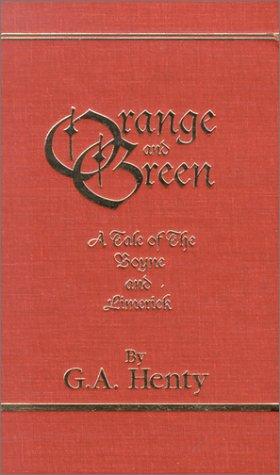
ORANGE AND GREEN:

 A TALE OF THE BOYNE AND LIMERICK
by G.A.Henty 

A few miles to the south of Bray Head, on the crest of a hill falling sharply down to the sea, stood Castle Davenant, a conspicuous landmark to mariners skirting the coast on their way from Cork or Waterford to Dublin Bay. 


(~326 pg)Read Online
(23.1 M)PDF
(~326 pg)EPUB
(~326 pg)Kindle
(~326 pg)Daisy
(523.3 K)Full Text
(8.8 M)DjVu


PREFACE.

MY DEAR LADS:
The subject of Ireland is one which has for some years been a very prominent one, and is likely, I fear, for some time yet to occupy a large share of public attention. For many years the laws in Ireland and the rights of Irishmen have been identical with those which we enjoy in England. The discontent manifested in the troubles of recent years has had its root in an older sense of grievance, or which there was, unhappily, only too abundant reason. The great proportion of the soil of Ireland was taken from the original owners and handed over to Cromwell's followers, and lor years the land that still remained in the hands of Irishmen was subject to the covetousness of a party of greedy intriguers, who had sufficient influence to sway the proceedings of government. The result was the rising of Ireland, nominally in defense of the rights of King James, but really an effort of despair on the part of those who deemed their religion, their property, and even their lives threatened by this absolute ascendency of the Protestant party in the government of the country. I have drawn my information from a variety of sources; but as I wished you to see the matter from the Irish point of view I have drawn most largely from the history of those events by Mr. O'Driscol, published sixty years ago. There is, however, but little difference of opinion between Irish and English authors as to the general course of the war, or as to the atrocious conduct of William's army of foreign mercenaries toward the people of Ireland.

Your sincerely,

G. A. HENTY.

Friday, August 6, 2010

When London burned;

A story of restoration times and the great fire. 
By G.A. Henty


The hero of this story was the son of a nobleman who had lost his estates during the troublous times of the Commonwealth. Instead of hanging idly about the court seeking favors, Cyril Shenstone determined to maintain himself by honest work. During the Great Plague and the Great Fire, which visited London with such terrible results, Sir Cyril was prominent among those who brought help to the panic-stricken inhabitants. This tale has rich variety of interest, both national and personal, and in the hero you have an English lad of the noblest type wise, humane, and unselfish.
(~456 pg)Read Online
(26.9 M)PDF
(~456 pg)EPUB
(~456 pg)Kindle
(~456 pg)Daisy
(831.4 K)Full Text
(9.6 M)DjVu
PREFACE.

We are accustomed to regard the Eeign of Charles II. as one of the most inglorious periods of English History; but this was far from being the case. It is true that the extravagance and profligacy of the Court were carried to a point unknown before or since, forming, by the indignation they excited among the people at large, the main cause of the overthrow of the House of Stuart. But, on the other hand, the nation made extraordinary advances in commerce and wealth, while the valour of our sailors was as conspicuous under the Dukes of York and Albemarle, Prince Rupert and the Earl of Sandwich, as it had been under Blake himself, and their victories resulted in transferring the commercial as well as the naval supremacy of Holland to this country. In spite of the cruel blows inflicted on the well-being of the country, alike by the extravagance of the Court, the badness of the Government, the Great Plague, and the destruction of London by fire, an extraordinary extension of our trade occurred during the reign of Charles II. Such a period, therefore, although its brilliancy was marred by dark shadows, cannot be considered as an inglorious epoch. It was ennobled by the bravery of our sailors, by the fearlessness with which the coalition of France with Holland was faced, and by the spirit of enterprise with which our merchants and traders seized the opportunity, and in spite of national misfortunes, raised England in the course of a few years to the rank of the greatest commercial power in the world.
G. A. HENTY.

Tuesday, May 11, 2010

Friends Though Divided:

A Tale of the Civil War
by G. A. Henty
England is torn by a great conflict between the Cavaliers and the Roundheads. The two heroes, Harry Furness and Herbert Rippinghall, are on opposite sides of the struggle, with adventures that spread to Ireland and Bermuda and the efforts of Charles II to regain the throne.
  
(~360 pg)Read Online
(27 MB)PDF
(~360 pg)EPUB (beta)
(~360 pg)Kindle (beta)
(~360 pg)Daisy (beta)
(583 KB)Full Text
(7.79 MB)DjVu


 PREFACE.

MY DEAR LADS: Although so long a time has elapsed since the great civil war in England, men are still almost as much divided as they were then as to the merits of the quarrel, almost as warm partisans of the one side or the other. Most of you will probably have formed an opinion as to the rights of the case, either from your own reading, or from hearing the views of your elders. For my part, I have endeavored to hold the scales equally, to relate historical facts with absolute accuracy, and to show how much of right and how much of wrong there was upon either side. Upon the one hand, the king by his instability, bad faith, and duplicity alienated his best friends, and drove the Commons to far greater lengths than they had at first dreamed of. Upon the other hand, the struggle, begun only to win constitutional rights, ended owing to the ambition, fanaticism, and determination to override all rights and all opinions save their own, of a numerically insignificant minority of the Commons, backed by the strength of the army in the establishment of the most complete despotism England has ever seen. It may no doubt be considered a failing on my part that one of my heroes has a very undue preponderance of adventure over the other. This I regret; but after the scale of victory turned, those on the winning side had little to do or to suffer, and one's interest is certainly with the hunted fugitive, or the slave in the Bermudas, rather than with the prosperous and well-to-do citizen.
Yours very sincerely,
G. A. HENTY.

Monday, May 3, 2010

Won by the Sword: The Thirty Years' War

By G.A.Henty
(~450 pg)Read Online
(38 MB)PDF
(~450 pg)EPUB (beta)
(~450 pg)Kindle (beta)
(~450 pg)Daisy (beta)
(789 KB)Full Text
(12 MB)DjVu


PREFACE.
In my preface to the Lion of the North I expressed a hope that I might some day be able to continue the history of the Thirty Years' War. The deaths of Gustavus and his great rival Wallenstein, and the crushing defeat of the Swedes and their allies at the battle of Nordlingen, brought the first period of that war to a close. Hostilities, indeed, never ceased, but the Swedes no longer played the leading part on the Protestant side that they had hitherto occupied. Oxenstiern, the great chancellor of Sweden, saw that the only hope of eventual success lay in engaging France in the struggle, and he and the Duke of Weimar went to Paris and pointed out to Richelieu that unless France intervened, Austria must become the master of all Germany, and as the ally of Spain would have it in her power to completely dominate France. Richelieu perceived the opportunity, made a treaty with the Swedes and Weimar, and engaged to grant large subsidies to the former, and to send an army to co-operate with the latter. Then began the second period of this long and terrible struggle, France now taking the place that Sweden had hitherto occupied, and bearing the brunt of the conflict. She emerged triumphant, with her territories largely increased, while Austria was crushed and humiliated, and Spain was dethroned from her position as the dominating power of Europe. The success of France was greatly due to the fact that her armies were led by two of the greatest military geniuses of all times, viz. Conde and Turenne, men of very different types, but equally great as commanders, and equally, at the time of which we are speaking, devoted to the cause of France. Both were men of extraordinary personal courage, and although one was as prudent and careful of the lives of his troops as the other was impetuous and careless at what cost he won his victories, they worked together with a harmony that could have hardly been expected among men so differently constituted. Although in the subsequent wars of the Fronde they took different sides, their friendship, except during a short period of alienation, was never shaken, and their admiration for each other's genius never abated.

G. A. HENTY.

Sunday, May 2, 2010

Maps of the Ancient Sea Kings


MAPS OF THE ANCIENT SEA KINGS by Charles Hapgood


I have Maps of the Ancient Sea Kings by Charles Hapgood in my library – fantastic book. I like this youtube but I believe the conclusions and illusions are wrong.
We have been brainwashed to believe in evolution – that man has “developed”. I don’t believe that at all.
Our entire outlook changes when we look at history from the opposite point of view. The Egyptians were consumed with “death” because, let us believe, it was a new occurrence for the age. Man before them lived long, long enough to do very incredible things like create fantastically technical structures and maps.

This blog is a work in progress. Come back often to see updates!