Monday, November 1, 2010

Bonnie Prince Charlie :

 a tale of Fontenoy and Culloden
By G.A.Henty
It was a dull evening in the month of September, 1728. The apprentices had closed and barred the shutters and the day?s work was over. Supper was laid in the long room over the shop, the viands were on the table, and round it were standing Bailie Anderson and his wife, his foreman John Gillespie, and his two apprentices.


Read Online(~238 pg)
PDF(10.5 M)
B/W PDF(5.2 M)
EPUB(~238 pg)
Kindle(~238 pg)
Daisy(~238 pg)
Full Text(380.8 K)
DjVu(3.6 M)


Watch the rest here

Monday, October 18, 2010

In the Irish brigade :

A tale of war in Flanders and Spain 
By G.A.Henty
In the Irish Brigade A Tale of War in Flanders and Spain - Preface - The evils arising from religious persecution, sectarian hatred, ill-government, and oppression were never more strongly illustrated than by the fact that for a century Ireland, which ha since that time furnished us with a large proportion of our best soldiers, should have been among our bitterest and most formidable foes, and her sons fought in the ranks of our greatest continental enemy. It was not because they were adherents of the house of Stuart that Irishmen left their native country to take service abroad, but because life in Ireland was rendered well-nigh intolerable for Catholics on account of the nature and severity of the laws against them, and the bitterness with which those laws were carried into effect. An Irish Catholic had no prospects of employment or advancement at home. He could hold no civil appointment of any kind he could not serve as an officer, nor even enlist 8s a private, in the army he could not hold land he was subject to imprisonment, and even death, on the most trifling and frivolous accusations brought against him by the satellites of the Irish Government. Not only could he not sit in the parliament of Dublin, but he could not even vote at elections...
 (~465 pg)Read Online
(10.6 M)PDF (Google.com)
(~465 pg)EPUB
(~465 pg)Kindle
(~465 pg)Daisy
(788.5 K)Full Text
(14.6 M)DjVu
(93.6 K)Metadata

Preface.

The evils arising from religious persecution, sectarian hatred,ill government, and oppression were never more strongly illustrated than by the fact that, for a century, Ireland, which has since that time furnished us with a large proportion of our best soldiers, should have been among our bitterest and most formidable foes, and her sons fought in the ranks of our greatest continental enemy. It was not because they were adherents of the house of Stuart that Irishmen left their native country to take service abroad, but because life in Ireland was rendered well-nigh intolerable for Catholics, on account of the nature and severity of the laws against them, and the bitterness with which those laws were carried into effect. An Irish Catholic had no prospects of employment or advancement at home. He could hold no civil appointment of any kind. He could not serve as an officer, nor even enlist as a private, in the army. He could not hold land. He was subject to imprisonment, and even death, on the most trifling and frivolous accusations brought against him by the satellites of the Irish Government. Not only could he not sit in the parliament of Dublin, but he could not even vote at elections. It was because they believed that the return of the Stuarts would mean relief, from at least some of their disabilities, and liberty to carry out the offices of their religion openly, and to dwell in peace, free from denunciation and persecution, that the Irish remained so long faithful to the Jacobite cause. It was not, indeed, until 1774 that the Catholics in Ireland were admitted to qualify themselves as subjects of the crown, and not until the following year that they were permitted to enlist in the army. Irish regiments had enlisted in France, previous to the Convention of Limerick; but it was the Irish army that defended that town, and, having been defeated, passed over to France, that raised the Irish Brigade to the position of an important factor in the French army, which it held for nearly a hundred years, bearing a prominent part in every siege and battle in Flanders, Germany, Italy, and Spain. A long succession of French marshals and generals have testified to the extraordinary bravery of these troops, and to their good conduct under all circumstances. Not only in France did Irishmen play a prominent part in military matters, but they were conspicuous in every continental army, and their descendants are still to be found bearing honoured names throughout Europe. Happily, those days are past, and for over a hundred years the courage and military capacity of Irishmen have been employed in the service of Great Britain. For records of the doings of some of the regiments of the Irish Brigade, during the years 1706-1710, I am indebted to the painstaking account of the Irish Brigade in the service of France, by J. C. O'Callaghan; while the accounts of the war in Spain are drawn from the official report, given in Boyer's Annals of the Reign of Queen Anne, which contains a mine of information of the military and civil events of the time.
Sincerly G. A. Henty.

Thursday, October 7, 2010

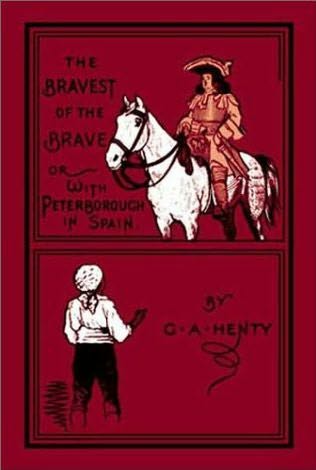
The Bravest of the Brave:


With Peterborough in Spain
By G.A.Henty
Unedited, unabridged, original format editions with original colored cover art, these Henty books reproduce the original in careful detail. There are few great leaders whose lives and actions have so completely fallen into oblivion as those of the Earl of Peterborough. This is largely due to the fact that they were overshadowed by the glory and successes of Marlborough. His career as General extended over little more than a year, and yet, in that time, he showed a genius for warfare which has never been surpassed.

(~412 pg)Read Online
(21.6 M)PDF
(18.1 M)B/W PDF
(~412 pg)EPUB
(~412 pg)Kindle
(~412 pg)Daisy
(594.7 K)Full Text
(9.6 M)DjVu


Preface
My dear Lads,
There are few great leaders whose lives and actions have so completely fallen into oblivion as those of the Earl of Peterborough. His career as a general was a brief one, extending only over little more than a year, and yet, in that time, he showed a genius for warfare which has never been surpassed, and performed feats of daring worthy of taking their place among those of the leaders of chivalry. The fact that they have made so slight a mark upon history is due to several reasons. In the first place, they were overshadowed by the glory and successes of Marlborough; they were performed in a cause which could scarcely be said to be that of England, and in which the public had a comparatively feeble interest; the object, too, for which he fought was frustrated, and the war was an unsuccessful one, although from no fault on his part. But most of all, Lord Peterborough failed to attain that place in the list of British worthies to which his genius and his bravery should have raised him, because that genius was directed by no steady aim or purpose. Lord Peterborough is, indeed, one of the most striking instances in history of genius and talent wasted, and a life thrown away by want of fixed principle and by an inability or unwillingness to work with other men. He quarrelled in turn with every party and with almost every individual with whom he came in contact; and while he himself was constantly changing his opinions, he was intolerant of all opinions differing from those which he at the moment held, and was always ready to express in the most open and offensive manner his contempt and dislike for those who differed from him. His eccentricities were great; he was haughty and arrogant, hasty and passionate, he denied his God, quarrelled with his king, and rendered himself utterly obnoxious to every party in the state. And yet there was a vast amount of good in this strange man. He was generous and warmhearted to a fault, kind to those in station beneath him, thoughtful and considerate for his troops, who adored him, cool in danger, sagacious in difficulties, and capable at need of evincing a patience and calmness wholly at variance with his ordinary impetuous character. Although he did not scruple to carry deception, in order to mislead an enemy, to a point vastly beyond what is generally considered admissible in war, he was true to his word and punctiliously honourable in the ordinary affairs of life. For the historical events I have described, and for the details of Peterborough's conduct and character, I have relied chiefly upon the memoir of the earl written by Mr. C. Warburton, and published some thirty years ago.
Yours sincerely,
G. A. HENTY.

Tuesday, September 28, 2010

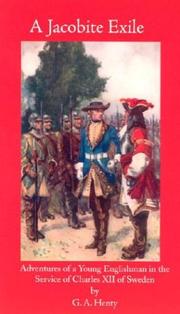
A Jacobite Exile;

The adventures of a young Englishman in the service of Charles XII. of Sweden.
By G.A.Henty
Sir Marmaduke was, at that time, only a child, but he still remembered how the Roundhead soldiers had lorded it there, when his father was away fighting with the army of the king; how they had seated themselves at the board, and had ordered his mother about as if she had been a scullion, jeering her with cruel words as to what would have been the fate of her husband, if they had caught him there, until, though but eight years old, he had smitten one of the troopers, as he sat, with all his force.
(~414 pg)Read Online
(25.6 M)PDF
(~414 pg)EPUB
(~414 pg)Kindle
(~414 pg)Daisy
(705.4 K)Full Text
(8.1 M)DjVu

PREFACE.

MY DEAR LADS,
Had I attempted to write you an account of thewhole of the adventurous career of Charles XII. of Sweden, it would, in itself, have filled a bulky volume to the exclusion of all other matter, and a youth who fought at Narva would have been a middle-aged man at the death of that warlike monarch before the walls of Frederickshall. I have therefore been obliged to confine myself to the first three years of his reign, in which he crushed the army of Russia at Narva, and laid the then powerful republic of Poland prostrate at his feet. In this way only could I obtain space for the private adventures and doings of Charlie Carstairs, the hero of the story. The details of the wars of Charles XII. were taken from the military history written at his command by his chamberlain, Adlerfeld, from a similar narrative by a Scotch gentleman in his service, and from Voltaire's history. The latter is responsible for the statement that the trade of Poland was almost entirely in the hands of Scotch, French, and Jewish merchants, the Poles themselves being sharply divided into the two categories of nobles and peasants.
Yours sincerely,
G. A. HENTY.

Wednesday, September 22, 2010

ORANGE AND GREEN:

 A TALE OF THE BOYNE AND LIMERICK
by G.A.Henty 

A few miles to the south of Bray Head, on the crest of a hill falling sharply down to the sea, stood Castle Davenant, a conspicuous landmark to mariners skirting the coast on their way from Cork or Waterford to Dublin Bay. 


(~326 pg)Read Online
(23.1 M)PDF
(~326 pg)EPUB
(~326 pg)Kindle
(~326 pg)Daisy
(523.3 K)Full Text
(8.8 M)DjVu


PREFACE.

MY DEAR LADS:
The subject of Ireland is one which has for some years been a very prominent one, and is likely, I fear, for some time yet to occupy a large share of public attention. For many years the laws in Ireland and the rights of Irishmen have been identical with those which we enjoy in England. The discontent manifested in the troubles of recent years has had its root in an older sense of grievance, or which there was, unhappily, only too abundant reason. The great proportion of the soil of Ireland was taken from the original owners and handed over to Cromwell's followers, and lor years the land that still remained in the hands of Irishmen was subject to the covetousness of a party of greedy intriguers, who had sufficient influence to sway the proceedings of government. The result was the rising of Ireland, nominally in defense of the rights of King James, but really an effort of despair on the part of those who deemed their religion, their property, and even their lives threatened by this absolute ascendency of the Protestant party in the government of the country. I have drawn my information from a variety of sources; but as I wished you to see the matter from the Irish point of view I have drawn most largely from the history of those events by Mr. O'Driscol, published sixty years ago. There is, however, but little difference of opinion between Irish and English authors as to the general course of the war, or as to the atrocious conduct of William's army of foreign mercenaries toward the people of Ireland.

Your sincerely,

G. A. HENTY.

This blog is a work in progress. Come back often to see updates!